UMG vs. DistroKid: AI Music & Distributor Accountability
September 16, 2026 | DAC Harmony Grove
For years, digital music distribution helped dismantle one of the biggest barriers between independent artists and the global music business.
An artist no longer needed a major record label to place a recording on the world's largest streaming platforms.
Upload the music.
Provide the metadata.
Choose a release date.
And a distributor could deliver that recording to listeners around the world.
That accessibility transformed independent music.
Now artificial intelligence, mass uploading and increasingly sophisticated forms of copyright infringement are forcing the industry to confront an uncomfortable question:
How much responsibility should a distributor have for what passes through its doors?
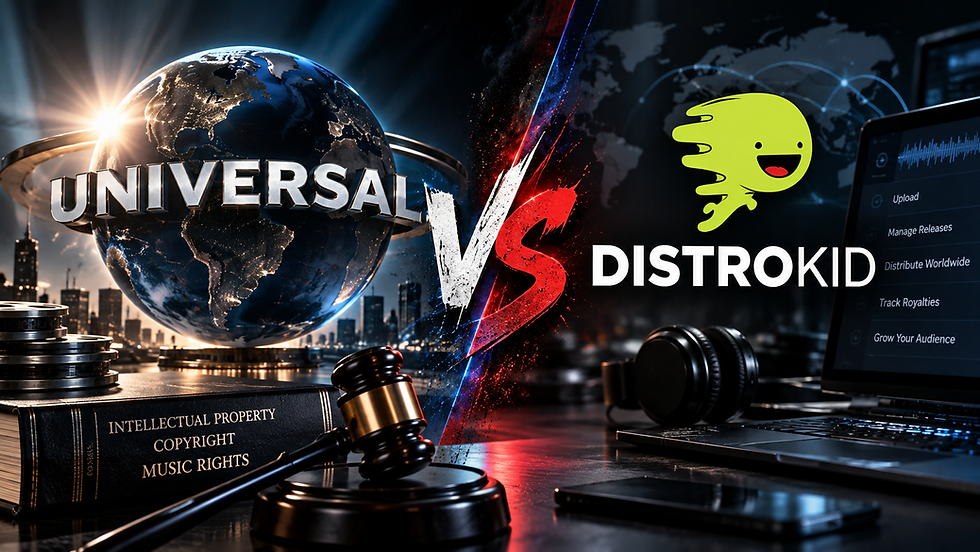
Universal Music Group has filed a federal lawsuit against independent distributor DistroKid, alleging copyright infringement and deceptive trade practices involving AI-generated music, unauthorized remixes, altered recordings and other allegedly infringing material.
DistroKid disputes the allegations.
The case has only begun, and the claims against the company have not been established in court.
But the questions raised by the lawsuit extend far beyond two companies.
They could eventually affect virtually every independent artist releasing music through digital distribution.
The Distributor Is Becoming Part of the AI Debate
Much of the music industry's artificial-intelligence battle has focused on creation.
What material was used to train an AI model?
Did the company have permission?
Can an AI imitate an artist?
Who owns an AI-generated recording?
Should artists be compensated?
Those questions remain unresolved.
But there is another piece of the music economy sitting between creation and consumption:
distribution.
Digital distributors are the gateways through which enormous amounts of independent music reach Spotify, Apple Music and other streaming services.
Historically, their value has partly come from making those gateways easier to access.
AI changes the scale of that challenge.
A person can potentially generate enormous quantities of audio faster than traditional musicians could ever record it.
When that capability combines with automated uploading, manipulated metadata, unauthorized samples, altered recordings or artificial streaming activity, the distributor becomes more than a delivery service.
t becomes part of the industry's integrity system.
4,562 Tracks in One Year
One allegation in Universal's complaint illustrates the scale of the issue.
The lawsuit points to an account called "Lofi Chill" that allegedly released 4,562 tracks during a 12-month period.
That is more than twelve tracks every day.
The significance isn't whether producing music quickly should somehow be prohibited.
Productivity isn't infringement.
Using AI isn't automatically infringement either.
The important issue is what happens when technology allows music to be manufactured and distributed at industrial scale while systems designed for a very different era attempt to determine whether the person uploading it actually owns what they claim to own.
Universal also alleges that DistroKid distributed unauthorized remixes, speed-altered versions of recordings, unlicensed samples and instrumentals containing newly added vocals.
Again, those remain allegations.
But the underlying problem is real:
Digital distribution was designed to remove friction. The next generation of distribution may have to put some friction back.
What Would Stronger Verification Look Like?
That could become one of the most important consequences of this dispute.
If distributors face greater legal, commercial or platform pressure to verify releases, independent musicians could eventually encounter more requirements before music goes live.
Identity verification.
Proof of ownership.
Sample-clearance documentation.
AI-generation disclosure.
Voice or likeness authorization.
Remix permissions.
More detailed metadata.
Additional review of suspicious release volumes.
Potentially slower approval for material triggering automated checks.
For legitimate artists, some of that could be inconvenient.
But there is another side.
Every system that makes releasing music frictionless also makes abusing that system frictionless.
The industry now has to determine where accessibility ends and accountability begins.
Independent Artists Have Something to Lose Too
It would be easy to interpret this lawsuit as a major label protecting its catalog.
That's certainly part of the dispute.
But independent artists also have reasons to care about distribution integrity.
Imagine releasing an original recording and discovering unauthorized versions appearing across streaming platforms.
Or finding your music repackaged under misleading metadata.
Or competing for discovery against thousands of automatically generated tracks optimized primarily to capture search traffic.
Or having fraudulent streaming activity consume portions of royalty pools intended to compensate legitimate listening.
Those aren't exclusively major-label problems.
They affect anyone trying to build sustainable value around original music.
Independent distribution only works when the ecosystem remains trustworthy enough for listeners, platforms and artists to participate in it.
AI Music Isn't One Thing
This distinction is becoming increasingly important.
AI-assisted music is not automatically AI-generated music.
AI-generated music is not automatically copyright infringement.
And AI-generated music is not automatically streaming fraud.
A producer using intelligent software to repair audio isn't doing the same thing as someone generating thousands of tracks.
A composer using AI to explore an arrangement isn't necessarily doing the same thing as someone impersonating an existing artist.
An artist voluntarily participating in a licensed AI platform isn't doing the same thing as someone uploading unauthorized derivatives of another artist's recordings.
Treating all of those activities as identical would create bad policy and bad industry practices.
The better distinction is between legitimate creative use and deceptive exploitation.
The Industry Is Beginning to Build an Accountability Chain
The timing of the DistroKid lawsuit is particularly significant.
The music business is simultaneously developing new mechanisms aimed at streaming integrity, AI disclosure, licensing and fraud prevention.
That suggests an accountability chain is beginning to emerge.
Creator → AI platform → Distributor → Streaming service → Listener → Royalty system
Every participant controls a different part of the process.
An AI company may have responsibilities surrounding training data and licensing.
A creator has responsibilities surrounding ownership and disclosure.
A distributor may increasingly have responsibilities surrounding verification.
Streaming services have responsibilities surrounding fraud detection and royalty accounting.
Rights holders have responsibilities surrounding accurate ownership claims.
And listeners need transparency about what they are actually hearing.
No single participant can solve the problem alone.
The Dangerous Alternative: Overcorrection
There is another risk that shouldn't be ignored.
When industries encounter widespread abuse, legitimate independent creators can become collateral damage.
More verification can become more bureaucracy.
Automated copyright systems can produce false positives.
Sample detection can misunderstand legitimate licensed material.
AI-detection systems can misidentify human-created work.
Smaller artists may have fewer resources to challenge erroneous takedowns than major rights holders.
So stronger enforcement alone isn't enough.
The systems also need meaningful appeals processes, transparency and reasonable standards of evidence.
Protecting creators shouldn't result in creating another gatekeeping structure that disproportionately burdens the same independent musicians digital distribution originally empowered.
Distribution May No Longer Be Just Delivery
This may ultimately be the biggest shift.
For years, artists largely evaluated distributors through relatively straightforward questions.
How much does distribution cost?
What percentage of royalties do they keep?
Which stores do they deliver to?
How quickly does music go live?
How quickly do they pay?
Those questions still matter.
But artists may increasingly need to ask others.
How does my distributor protect my catalog?
How does it handle fraudulent claims?
What happens when someone uploads my music?
How does it identify AI-generated content?
What information does it disclose to streaming services?
How does it handle disputes?
And what happens if my legitimate recording is incorrectly flagged?
Distribution may be evolving from a simple delivery service into something closer to a rights-management checkpoint.
The DAC Perspective
At DAC Harmony Grove, we believe independent access to the music industry should remain independent.
Technology allowing an artist to reach a worldwide audience without asking a traditional gatekeeper for permission has been one of the most important developments in modern music.
That shouldn't disappear.
But accessibility and accountability don't have to be enemies.
Artists deserve open pathways to release their work.
They also deserve protection from people exploiting those pathways to steal it.
AI can be part of legitimate music creation.
It can assist producers.
It can help composers.
It can accelerate technical workflows.
It can potentially create entirely new forms of music.
But transparency matters.
Permission matters.
Ownership matters.
And when music enters the commercial ecosystem, somebody eventually has to verify that the person monetizing it has the right to do so.
The Universal Music Group lawsuit against DistroKid won't settle every question.
The allegations will have to be tested in court, and DistroKid will have an opportunity to defend its practices.
But the larger question isn't going away.
The music industry spent years making it easier for anyone to distribute music.
Artificial intelligence may now force the industry to answer the harder question:
How do we keep that door open without allowing legitimate creators to be buried beneath everything that comes through it?
The answer could determine what independent music distribution looks like for the next decade.
DAC Harmony Grove| DA Blogger


Comments